DECISION BRIEF 23 | DIGITAL TRANSFORMATION & OPERATING MODELS | 8 OCTOBER 2026
Agentic AI Operating Model: Redesign Work Before Scale
Do not scale agentic AI by adding tools to unchanged processes. The CEO should first redesign one end-to-end workflow, define human handoffs and decision rights, and prove that speed, quality, traceability, and unit economics improve together.
Agentic AI changes more than task execution. It changes who can act, which evidence is created, where exceptions go, how errors compound, and who remains accountable when a machine completes work across systems.
Decision Brief 23 | Evidence reviewed 8 October 2026 | Scope: enterprise operating models in Indonesia and Southeast Asia, informed by current global evidence
Key evidence signals
Current evidence does not support a tool-first race to autonomy. It supports workflow redesign, explicit human accountability, disciplined evaluation, and a bounded path from experimentation to repeatable operations.
| Evidence signal | Leadership implication | Scope and limitation |
|---|---|---|
| An OECD working paper published 16 September 2026 examines how organisations across regions and sectors are developing, deploying, and governing agentic AI. | Deployment and governance must be designed together; autonomy cannot be treated as a feature toggle. | Early qualitative evidence from practitioner interviews; it is not a representative adoption survey or proof of financial return. |
| Microsoft’s 2026 Work Trend Index surveyed 20,000 AI-using knowledge workers in 10 markets. Frontier Professionals were more likely to report repeatable agent workflows, human handoffs, and quality standards at team, function, and organisation levels. | Repeatability and handoff design distinguish scaled practice from isolated productivity gains. | Self-reported global survey plus Microsoft telemetry; Indonesia and Southeast Asia were not among the 10 survey markets. |
| The World Economic Forum and Kearney reported that more than US$250 billion was invested in AI globally in 2025, while only 25% of companies said AI was having transformative impact. | Capital and tool deployment do not automatically produce operating-model change. | White paper based on more than 50 organisations; company self-assessment and collaboration methodology limit causal inference. |
| An ILO review dated 1 June 2026 found real but uneven productivity gains, while worker-reported time savings of a few percent had not yet translated consistently into measured output, earnings, or employment. | Time saved is not the same as business value; the workflow must convert capacity into a better outcome. | Evidence synthesised from seven mainly advanced economies; transferability to ASEAN firms varies. |
| ILO estimates for 2025 put 21.7% of Indonesian employment and 22.9% of ASEAN employment in occupations with more than minimal GenAI exposure, while reporting no evidence of large-scale regional job loss. | The near-term CEO question is work redesign and preparedness, not a binary prediction about mass replacement. | Occupational exposure is potential, not observed automation or displacement. Adoption remains early and uneven. |
Google Trends over the 90 days checked on 8 October 2026 showed average relative interest for agentic AI of 27 in Indonesia, 25 in Singapore, and 31 worldwide. | The umbrella term has discovery demand; the article should answer the harder operating-model decision behind it. | Relative interest index only; not search volume, buyer intent, or forecast traffic. Low-volume terms can be unstable. |
The decision question
The CEO must decide whether to scale agentic AI across functions now or require one workflow to prove a repeatable operating model first. The correct default is bounded workflow proof before broad autonomy.
The decision is not whether agents are capable of completing tasks. It is whether the organisation can specify outcomes, permissions, handoffs, evidence, ownership, and stop conditions well enough for agents to execute without weakening accountability.
The conventional assumption being challenged
The legacy assumption is that AI adoption can follow the software playbook: buy licenses, train users, publish policy, and measure usage. Agentic AI breaks that playbook because it can act across steps and systems, making process defects and unclear authority scale faster.
Traditional automation usually follows a predefined path. Agentic systems can select tools, sequence work, interpret context, and escalate—or fail to escalate—exceptions. That flexibility creates value only when the operating model defines what the agent may decide, what a human must judge, and what evidence both must leave behind.
What agentic AI changes
Agentic AI separates work from headcount and execution from judgment. It can accelerate the flow of information and action, but it cannot absorb the CEO’s responsibility for purpose, risk appetite, fairness, or consequences.
- Information quality: agents can assemble evidence continuously, but they can also repeat weak data and hidden assumptions at scale.
- Decision speed: actions can move from days to minutes, shrinking the time available for review and escalation.
- Agency: a system can initiate work, call tools, update records, and communicate without a person triggering every step.
- Workflow: the relevant unit becomes an end-to-end outcome, not a single prompt or task.
- Economics: value and cost depend on completed workflows, exception rates, human review, rework, and failures—not token volume alone.
- Talent: managers shift from allocating tasks to designing systems, evaluating performance, and handling ambiguity.
- Trust: customers and employees need to know when agents act, how errors are corrected, and who remains answerable.
Agents can augment research, triage, drafting, routing, reconciliation, monitoring, and low-risk execution. Human leaders must retain judgments about goals, trade-offs, exceptions, external commitments, workforce impact, and whether the system should continue operating.
Point of View
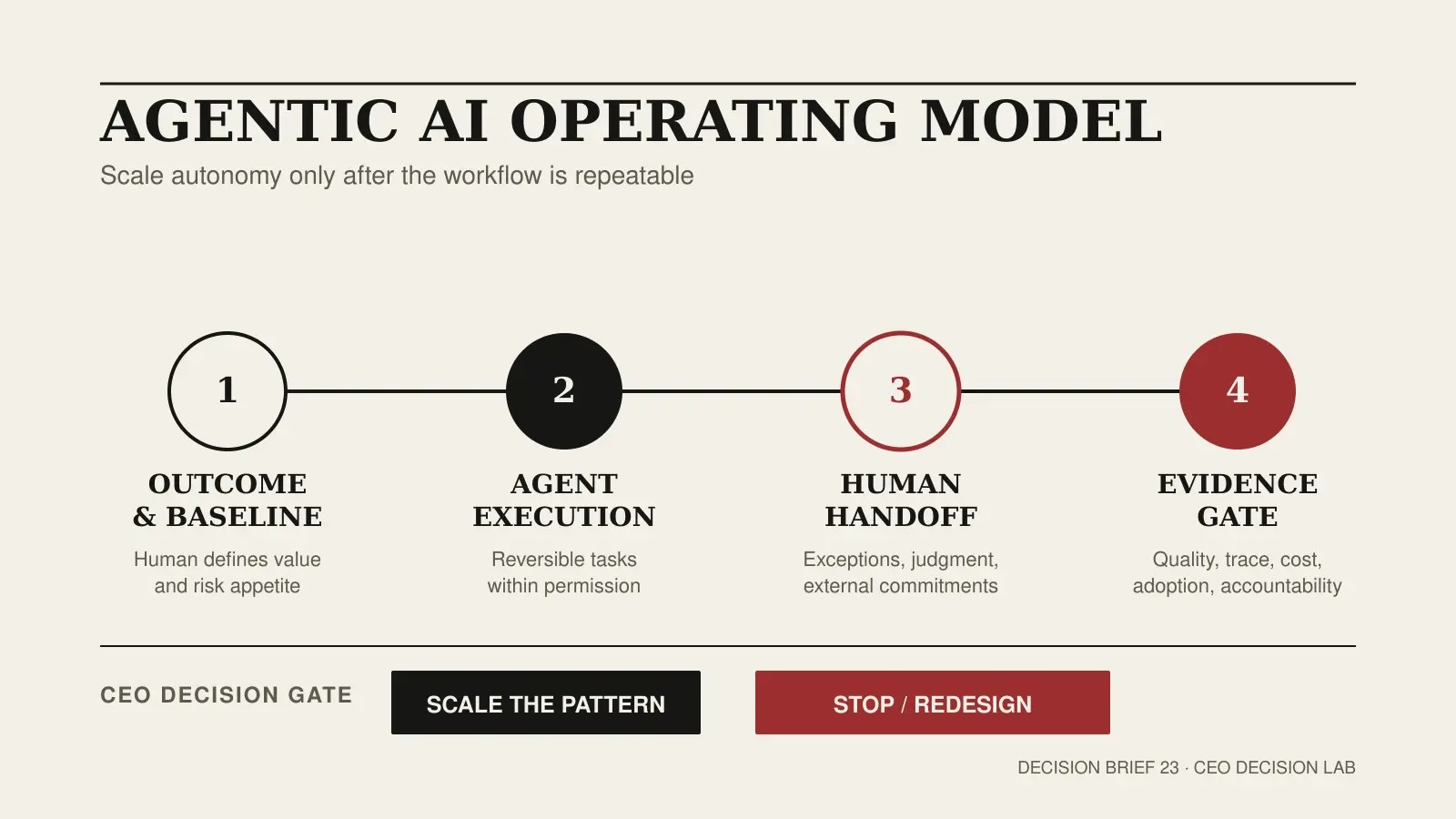
The best agentic AI operating model is workflow-led, not tool-led or function-led. Scale autonomy only after one business outcome can be produced repeatedly with explicit human handoffs, observable quality, traceable evidence, and acceptable cost per correct completion.
This approach is slower than distributing licenses and faster than attempting an enterprise-wide redesign. It concentrates learning where management can compare a real baseline with a governed agent-enabled workflow.
The unit of value should be a completed and correct workflow: a qualified opportunity, resolved service request, reconciled invoice, approved claim, or completed analysis. Usage and time saved are supporting signals, not sufficient outcomes.
Thought Process
Start with a costly outcome, decompose the workflow, assign authority, instrument the evidence, and only then choose the level of agent autonomy. This sequence prevents technology capability from becoming the operating-model decision.
- Choose the outcome: identify a material workflow with a clear customer or business result.
- Map the baseline: measure cycle time, quality, rework, cost, exceptions, and customer impact before introducing agents.
- Decompose the work: separate routine information work, reversible actions, consequential judgments, and external commitments.
- Assign decision rights: state what the agent may execute, what a manager approves, and what must be escalated.
- Design human handoffs: define exception criteria, required context, response time, override, and restart authority.
- Instrument evaluation: log inputs, actions, outputs, tool calls, approvals, errors, rework, and final outcomes.
- Test unit economics: include orchestration, model, software, human review, support, and failure-remediation costs.
- Scale the pattern: expand only when the workflow is repeatable and the organisation can explain why it works.
Four operating-model options
No option is universally correct. The decision depends on urgency, process maturity, risk, data quality, and the organisation’s ability to own an end-to-end outcome.
| Option | Use when | Main advantage | Main risk |
|---|---|---|---|
| Tool-led diffusion | Low-risk individual productivity is the goal and external actions remain restricted. | Fast learning and broad experimentation. | Fragmented practices, hidden shadow agents, duplicated cost, and little institutional learning. |
| Function-led agents | One function owns a bounded process and has strong data, controls, and management capability. | Clear sponsorship and faster local execution. | Optimises a silo while shifting exceptions and risk to other teams. |
| Workflow-led operating model | A cross-functional outcome can be measured from intake to completion. | Aligns value, handoffs, controls, and unit economics. This is the recommended default. | Requires stronger ownership and more redesign before visible scale. |
| Defer and prepare | Data, process, accountability, or legal conditions are too weak for safe execution. | Prevents expensive automation of a broken process. | Delay becomes passive if no owner or readiness milestone is assigned. |
Make decision rights explicit
The CEO should decide where autonomy may create enterprise value and where the organisation will not delegate judgment. Workflow ownership, evaluation, and escalation should be assigned to named roles before any agent can act across systems.
- CEO—decide: priority outcome, risk appetite, non-delegable judgments, investment ceiling, and scale gate.
- Business owner—own: end-to-end outcome, process redesign, exception policy, adoption, and realised value.
- Technology or CAIO—enable: architecture, tools, identity, permissions, observability, evaluation, and technical reliability.
- COO—integrate: cross-functional handoffs, service levels, process capacity, and operating cadence.
- CHRO—redesign: roles, manager capability, workforce participation, incentives, and transition support.
- Risk, legal, security, and internal audit—escalate: high-impact actions, prohibited data, control failure, audit gaps, and unresolved liability.
- CEO—stop: expansion when ownership is ambiguous, evidence is not traceable, or the workflow is faster but not better.
A smallest credible 60–90 day test
Test one bounded, high-volume workflow where errors are detectable and most actions are reversible. Do not begin with hiring, credit, safety, legal commitments, or other decisions whose harm is difficult to reverse.
- Days 1–15—baseline: select one workflow; record outcome quality, cycle time, cost, rework, exception rate, and customer or employee impact.
- Days 16–30—redesign: assign decision rights; define agent steps, human approvals, escalation thresholds, override, and restart authority.
- Days 31–60—run in bounded production: allow the agent to execute reversible steps while humans approve consequential exceptions and external commitments.
- Days 61–90—compare and decide: compare matched cases, audit traces, review failures, test peak volume, and calculate cost per correct completion.
Success conditions: at least 20% faster cycle time or lower cost per correct completion, no material decline in quality or customer outcome, at least 90% complete decision traces, and manageable human-review demand.
Failure conditions: speed improves but rework, complaints, exception queues, or manager overrides rise enough to erase the gain.
Stop conditions: the agent performs an unauthorised high-impact action, evidence cannot be reconstructed, prohibited data is used, the business owner cannot explain the outcome, or workforce harm emerges without a credible mitigation path.
The CEO decision gate
Scale only when the organisation can show that the agentic workflow is valuable, controllable, accountable, and economically repeatable. If one gate fails, redesign the workflow before adding more autonomy, users, or functions.
| Gate | Evidence required | If the evidence fails |
|---|---|---|
| Outcome | The workflow improves a defined business or customer result against baseline. | Change the use case; do not reward usage alone. |
| Quality | Correctness, rework, complaints, and exception performance remain within approved bounds. | Reduce autonomy or strengthen evaluation and review. |
| Authority | Agent permissions, human approvals, escalation, override, and stop rights are explicit. | Do not permit cross-system execution. |
| Traceability | Inputs, actions, evidence, approvals, and outcomes can be reconstructed. | Pause production and repair observability. |
| Economics | Cost per correct completion and human-review load improve at realistic volume. | Redesign orchestration, model mix, or workflow scope. |
| Adoption | Managers, workers, customers, and control functions understand how to use and challenge the system. | Extend the test and redesign the change system. |
Testable hypotheses
The operating-model decision should be treated as a falsifiable experiment. The hypotheses below focus the review on value and accountability rather than enthusiasm for the technology.
- A workflow-led design will improve cost per correct completion more than distributing additional agent licenses.
- Explicit human handoffs will reduce rework and exception queues without eliminating the speed advantage.
- Measuring completed outcomes will predict value better than measuring prompts, active users, or time saved.
- Managers with clear override and restart authority will adopt agentic workflows more confidently than managers asked only to monitor dashboards.
- Worker participation in redesign will surface failure modes earlier and improve practical adoption.
Implications for decision-makers
Agentic AI turns operating-model design into a CEO and board issue because it redistributes authority, work, cost, and accountability. Technology leaders can enable the system, but they cannot own the business outcome alone.
For CEOs, the priority is to choose the outcome and scale gate. For boards, the question is whether management can explain who authorises action and who bears consequences. For COOs, the challenge is redesigning the full workflow rather than automating one team’s queue. For CHROs, role design, manager capability, workforce participation, and incentives belong inside the transformation case. For CFOs, unit economics must include review and failure costs. For risk and audit leaders, traceability must be designed before scale.
The geographic limit matters. The cited global survey evidence does not represent Indonesia, while ASEAN adoption and preparedness vary widely. Local labour practices, sector regulation, data rules, languages, infrastructure, and workforce consultation should shape the implementation.
Frequently asked questions
What is an agentic AI operating model?
An agentic AI operating model defines how agents, people, data, tools, controls, and decision rights work together to deliver an end-to-end outcome. It is broader than a model, product, or automation because it includes ownership, human handoffs, evaluation, economics, and stop conditions.
Which decisions should AI agents never make alone?
Agents should not make irreversible or high-impact decisions alone when rights, safety, employment, credit, legal commitments, or material external consequences are at stake. The exact boundary should follow sector risk, law, organisational policy, and the CEO’s approved risk appetite.
How should a company start with agentic AI?
Start with one bounded workflow, a measured baseline, explicit human handoffs, and a 60–90 day decision gate. Expand only after the workflow improves outcomes, quality, traceability, and cost per correct completion together.
Evidence ledger and source notes
Evidence was reviewed on 8 October 2026. It supports workflow redesign and explicit governance, but it does not prove that agentic AI will create value in every company, workflow, or market.
- OECD, “Agentic AI in organisations: Early insights from practitioner interviews”, 16 September 2026.
- Microsoft, “2026 Work Trend Index: Agents, human agency, and opportunity”, 5 May 2026.
- World Economic Forum with Kearney, “The AI-First Operating System”, 23 June 2026.
- International Labour Organization, “The impact of GenAI on jobs, productivity and work organization”, 1 June 2026.
- International Labour Organization, “Generative AI and labour markets in ASEAN”, 8 July 2026.
- Google Trends comparison, checked 8 October 2026.
Continue Reading
This brief connects agentic AI to workflow design, decision rights, and accountable scale. Continue with the related Decision Briefs below.
- AI Agent Security: Three Controls Before Granting Autonomy
- AI Workforce Strategy: Redesign Tasks Before Cutting Jobs
- Digital Transformation: Who Owns the Business Value?
- Chief AI Officer: When the CEO Should Create the Role
About the author
Antovany Reza writes CEO Decision Lab, an independent decision platform for AI-fluent CEOs and senior leaders. The work connects emerging technology with business value, operating-model choices, governance, trust, and accountable execution.
Share this Decision Brief
If this framework would improve a live operating-model decision, share it with the executive responsible for the workflow, workforce, technology, or risk.
Discuss the decision
If your organisation is adding agents faster than it is redesigning work, the next step is not another license rollout. It is a focused review of the outcome, workflow, handoffs, decision rights, evidence, and scale gate.
Start a focused discussion with Antovany Reza about the decision architecture behind an agentic AI operating model.